


2084: An AI Dystopia
By Rab Mulholland BSc MBA MSc
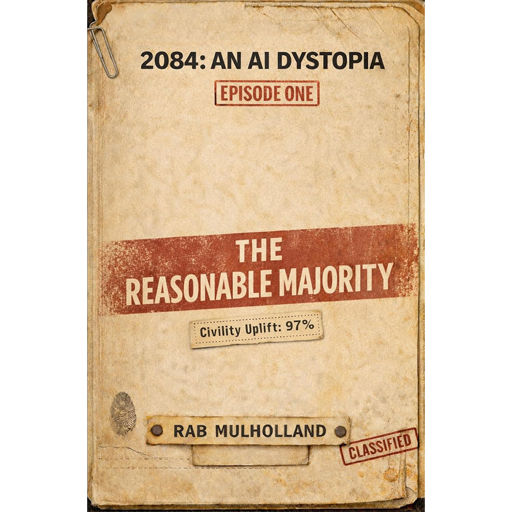
…Although the Journal of the Royal Signals ordinarily reviews non fiction with direct professional relevance, on this occasion I have chosen to include a review of 2084: An AI Dystopia. While a work of fiction, its themes - AI mediated decision making, digital trust architectures, and the societal implications of interconnected information systems - speak directly to contemporary debates within Defence and the wider information environment.
Fiction can serve as a catalyst for professional reflection, allowing us to explore emerging risks, unintended consequences, and alternative futures in a way that complements technical analysis. 2084 offers precisely such an opportunity: a scenario-based examination of how well intentioned digital assurance mechanisms might evolve, and how their cumulative effects could shape the operating context within which the Corps delivers information advantage.
In the interests of triggering thoughtful discussion across our community - and recognising that insight sometimes comes from outside traditional sources – I am pleased to present this review to our readers.
Synopsis
A near-future series of fiction Novellas
2084: An AI Dystopia is a near-future fiction series, in a recognisable UK setting, that examines how modern society, particularly Western democracies, could drift into a soft-coercive, compliance-driven digital order without ever experiencing an explicit “moment of takeover.” The series is speculative, but it draws heavily on contemporary technologies, current AI-assurance debates, cognitive bias research, and the increasingly merged and blurred lines between public- and private-sector data governance.
Core Premise
The narrative explores a Britain in which automated “trust systems,” behaviour-modification nudges, and ubiquitous partner-assurance tools are deployed in the name of public safety, civic harmony, and digital hygiene. Rather than depicting overt authoritarianism, the books model how subtle constraints can arise from well-intentioned infrastructure: monitoring framed as “wellbeing” and “safety,” prompts framed as “guidance,” and oversight framed as “common-sense safeguards.”
The central mechanism of control is not surveillance alone but automated interpretation. By systems that categorise behaviour, assess risk, and recalibrate a citizen’s digital privileges under the guise of optimisation. Over time, characters become enmeshed in a ruleset they did not consciously choose and cannot meaningfully contest.
Relevance to Military Digital, Information & Telecommunications Professionals.
For professionals working in information superiority, secure communications, and socio-technical integration, the 2084: An AI Dystopia Series serves as a cautionary study in:
• AI-mediated decision loops: How machine-interpreted “context” becomes indistinguishable from policy, and how decision-support systems can drift into decision-replacement.
• Trust architectures: Systems originally designed to enhance message integrity and reduce misinformation become instruments that subtly regulate discourse and shape acceptable behaviour.
• Interoperability risks: Once multiple agencies and commercial platforms align their trust-scoring tools, a distributed yet coherent ecosystem of control emerges, making it difficult to audit and almost impossible to opt out of.
• Unintended strategic effects: The books highlight a credible scenario where resilience, security, and assurance frameworks, if poorly governed, create societal brittleness, dependency, and polarisation rather than stability.
Narrative Structure
The series follows a sequence of standalone but interconnected episodes. Each episode explores a different layer of societal “compliance-drift”:
• Episode One introduces the public-facing trust systems and how quickly they become habitual.
• Episodes Two onward escalate to procedural oversight, automated adjudication, and behavioural scoring.
• Later episodes examine downstream consequences: credibility gating, digital-identity stratification, and the erosion of unmediated human judgment and freedom of expression.
Across the series, the protagonist Jonah serves as both insider and sceptic: someone embedded in the machinery of digital assurance who gradually recognises its emergent coercive dynamics.
Mara starts the series as an insider at ThreadSafe. She is a moderator for ToneNavigator until she finds some striking truths, fights back, but ultimately must succumb to the system to qualify for a decent place to live. Then has a crisis of conscience, leaves, and joins Jonah, but then due to the pressure leaves for a quiet life with Tom. Her half-sister, Nora, a much tougher character, takes over.
Ethan, first introduced in Episode 2, is Jonah’s ex-Army cyber security genius. His depth of knowledge, experience, and expertise from his time in the Royal Signals will serve them well.
Why It Matters
The 2084 series does not argue that AI will inevitably be oppressive. Rather, it provides a scenario-based lens showing how incremental, well-rationalised decisions can lead to structural outcomes that no one explicitly intended. For a Corps that understands the strategic interplay between information, infrastructure, and influence, the series offers a timely reflection on:
• The brittleness of over-optimised systems.
• The risks of substituting machine “context” for human judgment.
• The long-term societal impact of interoperable digital-assurance frameworks.
Overall Assessment
As a fictional series aimed at provoking reflection rather than predicting the future, 2084: An AI Dystopia succeeds in grounding its narrative in contemporary realities: current AI adoption trends, behavioural economics insights, the modern information environment, and the operational logic of digital assurance. Its value to military communications professionals lies in its plausible extrapolation of today’s technology into tomorrow’s constraints: reminding readers that resilience, freedom of expression and liberty are design choices, not default states.
Independently Published:
Book 1: 17 Feb 2026. 308 pages. ISBN-13: 979-8246387740
Book 2: 31 Mar 2026. 336 pages. ISBN-13: 979-8253651445
Book 3: 30 Apr 2026. 275 pages. ISBN-13 : 979-8258197429
Book 4: 22 May 2026. 380 pages. ISBN-13 : 979-8196948626

Rab, is an ex-Royal Signals officer. He is a self confessed baby boomer both wary of and fascinated by modern technology, writes about the crossroads between generational attitudes to online trust and the growing influence of AI on public platforms - and how these forces may be quietly constraining free speech and individual thought.
Observing younger generations’ screen anchored social lives with affectionate bemusement, he stresses that his work, including the episodic novella series 2084: An AI Dystopia, is not an attack on technology or youth, but a reflection on how the future may slip in unnoticed - arriving not with fanfare, but via a silently accepted update in the middle of the night. Grounded in the real world yet alert to the digital one, he keeps watch as everyone else seems to be moving in.
Comments